Last updated 2026-08-21
TL;DR
A scopist is a transcript editor who cleans a court reporter's raw CAT file into a readable record. You do not take the live record, and there is no federal scopist license. Most people start as 1099 freelancers, learn one CAT program, and charge by the page. Confirm reporter rules with the state board where the transcript will be used.
What is a scopist?
A scopist is a transcript editor who takes a court reporter's raw CAT translation and turns it into a readable transcript. You fix untranslates, speaker identification, punctuation, formatting, and name consistency. You do not take the live record. You are not the certifying reporter in a normal freelance setup.
The work starts after the reporter writes on a stenotype and CAT software tries to translate those outlines into English. That first pass is rough. "There" lands on "their." A doctor name splits into two nonsense words. Colloquy looks like a stack of fragments. You listen with your eyes. You use the audio when the reporter gives it to you. You do not guess a drug name to look clever.
People search "what is scopist" and get career-site fluff. The job is production editing under deadline. It is closer to copy desk work than to being a lawyer. Speed matters because reporters bill by the page and they will not wait a week on a daily.
BLS does not publish a separate wage series for scopists. The closest official occupation is court reporters and simultaneous captioners, SOC 27-3092. [1] That series mixes official reporters, captioners, and related work. Use it as context, not as your personal rate card.
A good scopist is picky about names. A good scopist is quiet about the reporter's clients. If you cannot leave a flag on a bad outline, you are not ready for paid pages.
How do you start as a scopist?
You start by learning transcript English, one CAT workflow, and a reporter's style sheet, then you take overflow pages for pay. There is no federal starter license. Most people begin as independent contractors.
Here is the order I would follow. Read real transcripts until Q and A, colloquy, and parentheticals feel normal. Get student or scopist access to one CAT program and practice on sample jobs. Write a one-page rate note that covers standard pages and rush pages. Ask reporters who already have more work than hours. Deliver the first jobs early. Invoice the same week.
BLS writes, "Court reporters and simultaneous captioners typically need a postsecondary nondegree award from a community college or technical institute." [2] That sentence is about reporters and captioners. It is not a scopist mandate. Plenty of usable scopists never finished reporting school. Plenty of reporting-school leavers scope while they decide whether to sit for a state exam.
Do not wait for a national apprenticeship. It does not exist. Compare adjacent paths in scopist guide 17 if you are still choosing a lane.
Confirm any court-facing claim with the board where the transcript will be used. I will not invent a processing time. Boards change forms, and a blog post is not a credential.
Do you need a license to work as a scopist?
Usually no, not as a scopist. Most states license or certify the person who takes the record, not the editor who cleans the English. There is no federal scopist license.
California requires a certificate before a person may engage in the practice of shorthand reporting. That rule sits in Business and Professions Code section 8016. [8] Texas Government Code Chapter 154 requires certification before a person may engage in shorthand reporting or be appointed an official or deputy reporter. [9] Those rules target reporting, not editing.
Federal district courts record proceedings under 28 U.S.C. § 753. That statute talks about official court reporters and a verbatim record. It does not create a scopist credential. [7]
Advertise as a certified court reporter without the credential and you have a problem. Advertise as a scopist who edits for working reporters and you are in a different box. Some agencies and courts still have contractor rules. Confirm with the relevant board. Do not treat a Facebook group as the board.
A private "national scopist certificate" from a random website is not a state license. I would not pay for one to impress a reporter. Clean sample pages impress a reporter.
How is a scopist different from a court reporter?
A court reporter takes the live record and is responsible for the certified transcript. A scopist edits that reporter's file. An audio transcriber starts from sound with no steno file. Those are three jobs, and mixing the titles on a website is how people get into credential trouble.
| Role | Live record | Typical state credential | Common pay unit |
|---|---|---|---|
| Court reporter | Yes | License or certification in many states | Salary or per page |
| Scopist | No | Usually none as scopist | Per page |
| Audio transcriber | No | Usually none | Per audio hour or per page |
NCRA's public career material is built around becoming a reporter or captioner, plus reporter certifications. [10] That is the professional body reporters actually talk about. Scoping sits beside that world as a production role.
Official federal reporting sits under the judiciary's court reporting program, including maximum transcript rates the courts publish. [6] A scopist does not set those court rates. A scopist sets a private page rate with a reporter.
Want more comparison pieces after this? Scopist guide 23 is a logical next click. I would not call myself a reporter on a website if I only scope. It is sloppy, and it can look like you are claiming a credential you do not have.
What does first-year scopist work look like?
First-year scopist work is file in, clean pages out, usually from a spare room. You will live in untranslates, job dictionaries, and audio that cuts out when a witness turns away.
A normal day (when work exists) looks like this. A reporter sends a job with a style sheet and a deadline. You open it in CAT. You run a spell. You fix speakers. You research names. You pass through Q and A for sense. You send a proof. You wait for the reporter's changes. You invoice.
Deadlines are the real boss. A daily means the reporter promised pages fast, often the same day. Take dailies in month one and you will miss something. Take standard turnaround until your error rate is boring.
Work is lumpy. Deposition volume does not follow a government fiscal year. Nobody has a clean national dataset on first-year scopist hours. The closest official employment picture is still the BLS court reporter series, which is a different job. [3]
Ergonomics will get you if you pretend they will not. Cheap chair, laptop only, eight hours of punctuation. That is how you buy a wrist problem. I would spend money on a real chair and an external keyboard before I spent a dime on a branded academy hoodie.
Read scopist guide 35 if you are comparing first-year setups.
How much does a scopist make?
You make what you negotiate per page, minus the pages you redo, minus tax. There is no official national scopist wage table.
BLS publishes pay for court reporters and simultaneous captioners (SOC 27-3092) on the Occupational Outlook Handbook and the Occupational Employment Statistics pages. Read the live median and percentile rows there. Do not trust a blog that reprints last year's number as if it were your scoping rate. [1] [3]
Private scoping rates move with turnaround, difficulty (medical files are slower), and whether you or the reporter owns the software setup. I will not invent a current market page rate. Ask three working reporters in your niche this month. Write down what they actually pay, not what a course sales page wishes they paid.
Federal courts publish Judicial Conference maximum transcript rates for official work. [6] Those rates are a ceiling for court-ordered transcripts, not your freelance scoping invoice. Do not quote a federal original-page maximum as if it were your take-home.
Some people chase CART or captioning numbers because those worlds sit near reporting. Different skill. Different clients. Do not assume a captioning figure is a scoping figure.
Rush work pays more because it wrecks your evening. If you cannot say no to a 2 a.m. daily, you will hate the job by month four. For more pay-path contrasts, see scopist guide 53.
What software, hardware, and paper do you need?
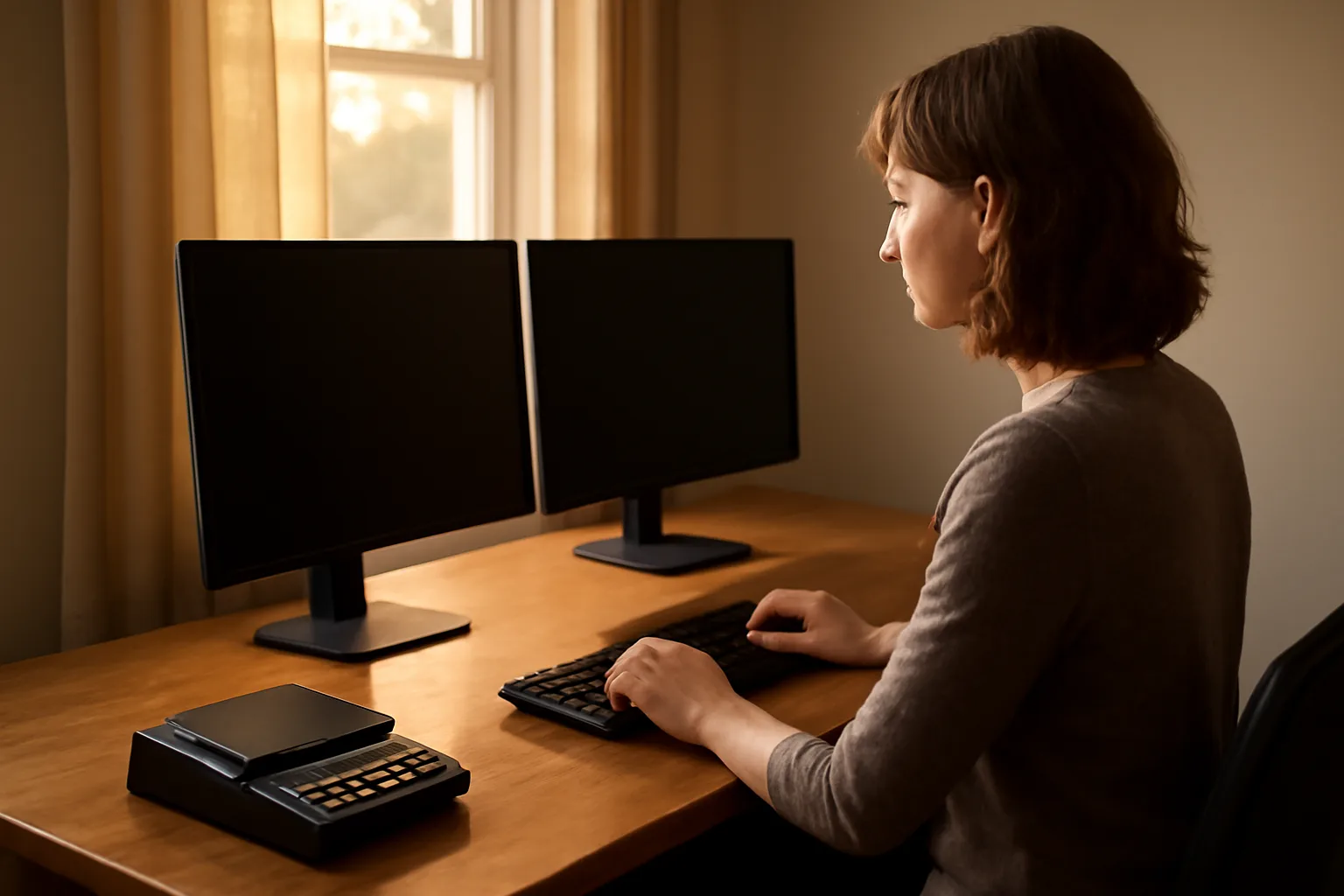
You need a reliable computer, two monitors if you can, headphones, a backup drive, and access to the CAT software your reporters use. You do not need a full stenotype unless you also write.
Common CAT names in this trade are Stenograph Case CATalyst and Advantage Software Eclipse. Reporters pick the platform. You follow. Student or scopist licenses exist for some products. Confirm current license terms with the vendor. I will not invent a fee.
Paper still shows up. Some firms want a specific transcript stock or a bound copy. Many jobs never leave PDF. Buy paper when a client names a stock, not in a panic carton of 20 boxes. Letterhead is optional. A clean invoice is not.
You can build a rate sheet and a simple agency packet in any word processor. ScopistPath sells a $99 one-time Scopist Rate + Agency Kit at /start if you want that packet prebuilt. I would not subscribe to a monthly tool just to store three numbers.
Compare kit-versus-DIY thinking with scopist guide 47 if you like checklists. Internet that drops during a daily is a business problem, not a vibe. Get a backup hotspot before you take rush work.
How do you get your first scoping jobs?
You get first scoping jobs from working reporters, not from a national hiring portal. Agencies sometimes farm overflow. Cold email works if you attach a short, clean sample and a real turnaround promise.
I would not buy a lead list. I would ask instructors (if you sat in a reporting program), local agency owners, and reporters you already know. Offer to take the ugly medical job at a fair page rate. Deliver it early once. That is the whole marketing plan for year one.
Turnaround lies get you fired once. If you need 72 hours, say 72 hours. Reporters remember the person who blew a daily more than they remember a clever logo.
NCRA's career pages point people toward reporter and captioner training and membership communities. [10] Those rooms are full of reporters who need help when a trial runs long. Be useful. Do not spam.
Samples beat adjectives. Two to four pages of before-and-after (with names stripped) will get you farther than a slogan.
If a stranger asks you to certify a transcript in a state that licenses reporters, stop. That is their license talking, not yours. Confirm with the board. See scopist guide 59 for more contrast on adjacent roles.
What taxes and paper hit a freelance scopist?
If you freelance, you are probably a self-employed contractor. The IRS says the self-employment tax rate is 15.3 percent. In the agency's words, "The self-employment tax rate is 15.3%. The rate consists of two parts: 12.4% for social security (old-age, survivors, and disability insurance) and 2.9% for Medicare (hospital insurance)." [4]
That 15.3 percent sits on top of income tax. The Social Security wage base changes. Confirm the current contribution and benefit base on the Social Security Administration table before you estimate next year. [12]
Reporters and agencies who pay you $600 or more in a year generally use Form 1099-NEC. [5] You file a Schedule C with Form 1040 for the business profit or loss. [13]
The IRS independent contractor page is the test for control, not your preference for the word freelance. [11] If one shop sets your hours, your tools, and your method, you may be an employee. That is a facts-and-circumstances problem. I am not your tax preparer.
Open a separate bank account. Keep invoices. Track software, internet, and a share of your office. Pay estimated tax so April is not a surprise. That is the real first-year paper path, and it matters more than a new mouse.
Should you go to court reporting school first?
Only if you want to become a reporter or you already paid for the seat. School is a slow, expensive way to learn scoping alone.
Reporting programs exist because states and NCRA built reporter credentials around speed tests and written knowledge. [10] BLS still lists a postsecondary nondegree award as typical for reporters and captioners. [2] Scoping does not have that same school-to-license pipeline.
Here is a blunt take. If you love steno and you will sit for the RPR or a state CSR, stay in school. If you bounced out of speed building and you like English more than writing 200-plus words a minute, scope. Do not keep paying tuition to avoid admitting the switch.
Speedbuilding for months while you already know you will not write is a sunk-cost trap. Leave when you know.
A short CAT class or vendor training can be worth it. A multi-year reporting program used only as scopist school is usually a waste of money. Side-by-side training paths are easier to weigh after scopist guide 11.
What should you confirm with a state board?
Confirm who may take a record, who may certify a transcript, and whether a contractor in your position is even mentioned. Then stop guessing.
Start with the state where the proceeding happened, not the state where your desk sits. California's shorthand-reporting certificate rule is in BPC 8016. [8] Texas Chapter 154 is the reporter gate, not a hidden scopist permit. [9] Official federal reporting follows 28 U.S.C. § 753. [7]
Ask the board (or read the statute) these things. Is scoping mentioned at all. Can a non-reporter touch the file. Are there contractor registration rules for people who help produce transcripts. What words are reserved, such as certified shorthand reporter or official court reporter.
I will not give you a current fee, quota, or processing time. Those change. The board's fee page beats me.
If two states touch the job, read both. Do not take legal advice from a rate sheet. More board-versus-board contrast lives in scopist guide 71.
What is a waste of money in year one?
A printed national scopist certification from a site you cannot map to NCRA or a state board is a waste. A full reporting program you will never test out of is a waste if your only goal is scoping. A warehouse of transcript paper before anyone orders a bound copy is a waste.
Buy the chair, the backup drive, the CAT access your reporters actually use, and an accountant hour if tax forms scare you. Skip the engraved business gadgets.
Near the end of year one, reread your invoices. If one client is 80 percent of revenue, you do not have a business yet. You have a single reporter who likes you. That can still be a good living. Call it what it is.
Keep samples. Keep a simple style checklist. Keep saying no to work you cannot make accurate. Accuracy is the whole product.
If you want the kit mentioned earlier, it lives at /start. ScopistPath is an independent publisher, not a law firm and not a service company. This article should still work if you never click that link.
Frequently asked questions
What is scopist?
A scopist is a transcript editor who cleans a court reporter's raw CAT translation. You fix untranslates, speakers, punctuation, and format. You do not take the live record and you do not certify the transcript in a normal freelance setup. BLS has no separate scopist series. The closest official occupation is court reporters and simultaneous captioners, SOC 27-3092.
How do you start scopist?
Learn transcript format, get access to one CAT program, write a simple page-rate note, and take overflow from working reporters. There is no federal scopist exam. Most starters are 1099 contractors. Confirm any court-facing claim with the board where the record will be used. Do not wait for a national apprenticeship. It does not exist.
Is scopist a licensed job in the United States?
Usually no. States that regulate this field typically certify or license shorthand reporters, not editors. California BPC 8016 and Texas Government Code Chapter 154 are reporter gates. 28 U.S.C. 753 covers official federal reporters. A private website certificate is not a state license. Confirm reserved titles with the relevant board.
Can you scope without going to court reporting school?
Yes. BLS says reporters and captioners typically need a postsecondary nondegree award. That line is not a scopist mandate. School helps if you already started it or you still want a reporter credential. Paying a multi-year reporting program only to scope is often a waste. A short CAT class can be enough to start practice files.
What CAT software do scopists use?
You use whatever your reporters use. Case CATalyst and Eclipse are common. Student or scopist licenses exist for some products. Confirm current terms and prices with the vendor. I would not buy two platforms in month one. Follow the first reporters who actually send you files.
How do scopists charge, per page or hourly?
Most freelance scopists charge per page, with a higher figure for rush or same-day work. Hourly billing shows up on odd cleanup jobs, but it is not the default. There is no official national page-rate table. Ask working reporters what they pay this month. Do not quote federal court maximum transcript rates as your take-home.
Do you need errors and omissions insurance as a scopist?
Some agencies ask for it. Many first-year freelancers start without it and add a policy when a client requires a certificate of insurance. I am not your broker. Ask two reporters what their agencies actually demand, then get a quote. A policy does not replace careful flagging of bad outlines.
Can a scopist certify a transcript?
Not in a normal setup. Certification is the reporter of record's act. If someone asks you to sign as the official reporter and you are not one, stop and read the state statute. California and Texas regulate shorthand reporting practice. Federal official reporting sits under 28 U.S.C. 753. Confirm with the board.
What is an untranslate?
An untranslate is a steno outline the CAT dictionary did not turn into English, or turned into the wrong English. It may show as raw steno, a blank, or a wrong homophone. Your job is to resolve it from context and audio, or flag it. Inventing a medical term to keep the page pretty is how you lose the reporter.
Are scopists employees or contractors?
Most starters invoice as independent contractors and get a 1099-NEC if pay hits the IRS reporting threshold. The IRS looks at control of hours, tools, and method, not at the word freelance. If one shop treats you like staff, you may be an employee. File Schedule C for true self-employment profit or loss. Get a tax pro if the facts are messy.
How long until you can take paid pages?
Nobody has good public data on time-to-first-invoice. If you already read transcripts and can run one CAT program, paid overflow can start as soon as a reporter trusts a sample. If you are new to legal format, give yourself weeks of practice files before you promise a daily. Accuracy first. Speed follows.
Does NCRA certify scopists?
NCRA's well-known credentials are built around reporters and captioners, such as the RPR path on its certification pages. That is not a government scopist license. Membership communities can still help you meet reporters who need overflow. Do not treat an NCRA logo as permission to certify a record you did not take.
What states should you check first?
Check the state where the proceeding happened. Then check any second state on the caption if the case was removed or the reporter is licensed elsewhere. California and Texas are strict reporter-credential states and are good statutes to read even if you live somewhere else. Federal official work follows 28 U.S.C. 753 plus judiciary program pages.
Do you need transcript paper at home?
Not on day one. Many jobs ship as PDF only. Buy the stock a client names, in the quantity they name. A panic warehouse of paper is a waste. A working printer and a backup of the file are not a waste. Invoice paper and postage only when the client asked for a hard copy.
Sources
- BLS Occupational Outlook Handbook, Court Reporters and Simultaneous Captioners: BLS groups this work as court reporters and simultaneous captioners (SOC 27-3092) and publishes the official pay and outlook tables there, with no separate scopist series.
- BLS OOH, How to Become a Court Reporter or Simultaneous Captioner: BLS states that court reporters and simultaneous captioners typically need a postsecondary nondegree award from a community college or technical institute.
- BLS Occupational Employment and Wage Statistics, 27-3092: OES publishes employment and wage estimates for court reporters and simultaneous captioners under SOC 27-3092.
- IRS, Self-Employment Tax (Social Security and Medicare Taxes): The IRS self-employment tax rate is 15.3 percent, made of 12.4 percent Social Security and 2.9 percent Medicare.
- IRS, About Form 1099-NEC: Nonemployee compensation is reported on Form 1099-NEC.
- U.S. Courts, Court Reporting Program and Transcript Rates: The federal judiciary runs the court reporting program and publishes maximum transcript rates for official court transcripts.
- U.S. Code, 28 U.S.C. § 753 (Reporters): Federal law provides for official court reporters and verbatim recording of designated court proceedings.
- California Business and Professions Code § 8016: California requires a certificate to engage in the practice of shorthand reporting.
- Texas Government Code Chapter 154 (Court Reporters Certification and Regulation): Texas Chapter 154 governs court reporter certification and restricts uncertified shorthand reporting practice.
- National Court Reporters Association, Certifications: NCRA's public credentials, such as the RPR, are built around reporters and captioners, not a scopist license.
- IRS, Independent Contractor Defined: IRS classification turns on whether the payer has the right to control the work, not on the freelance label.
- Social Security Administration, Contribution and Benefit Base: The Social Security wage base used in self-employment tax calculations is published and updated by SSA.
- IRS, About Schedule C (Form 1040): Sole proprietors report business profit or loss on Schedule C (Form 1040).